
How to plan your first trip abroad
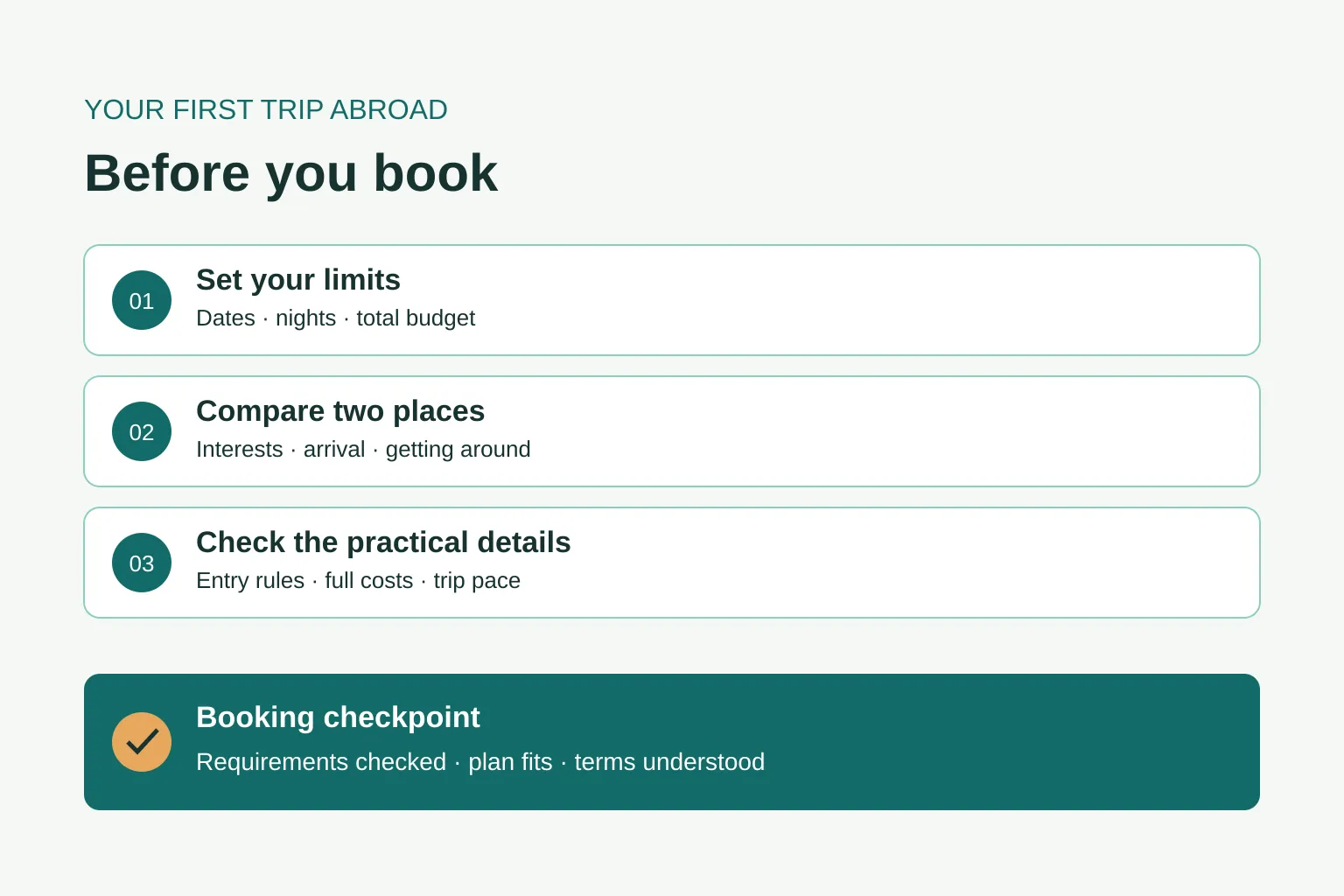
To plan your first trip abroad, start with your available dates, total budget and what you want to do, then compare two destinations that fit. Check passport and entry requirements before committing money, price the whole trip and sketch a manageable route. Book only when those pieces work together; detailed sightseeing and packing can come later.
How to plan your first trip abroad: start with four answers
Write a short planning note before opening more booking tabs:
- When: your possible departure dates and the day you need to be home.
- How long: count nights away as well as days off. An overnight flight can use time without giving you a night at your destination.
- What you can spend: a whole-trip limit, with the currency and number of travelers.
- What matters: two things you want from the trip, plus one concern you want to resolve.
“Six nights, USD 1,800 for one person, museums and time by the water, worried about getting from the airport” is enough to begin. You don't need a finished itinerary.
Compare two destinations against the trip you want
Choose two places that interest you rather than searching for the single “best” first-trip destination. Compare the same dates and number of nights so the trade-offs are visible.
| Question | What to look up | What the answer changes |
|---|---|---|
| Can I get there without a journey I dread? | Total travel time, connections and arrival time | Whether the route suits your comfort and time off |
| Can I do the things I care about? | Opening days, seasonal access and distances | Whether your priorities fit those dates |
| Can I manage everyday travel? | Airport transfer, local transport and walking distances | Where to stay and whether you need a car |
| Does the whole trip fit my limit? | Transport, accommodation and daily spending | Whether to change place, dates or length |
| Can my needs be met? | Accessibility, food needs and accommodation facilities | Which options to keep on the shortlist |
Use maps to check distances, then verify routes and timetables with the transport operator. A hotel described as “near the city” may still leave you with a long journey to the places you want to visit.
If both destinations fit, choose the one whose trade-offs you're happier living with. A simpler arrival may matter more to you than fitting in another attraction.
Check documents and entry rules before paying
Entry requirements depend on your passport, destination, transit countries, travel purpose and dates. Check the destination government's immigration or consular website for passport validity, visas or travel authorizations, permitted stay and required documents. Check any country where you change planes, too, including whether your connection requires entering that country.
Use your own government's travel advice alongside the destination's official rules. For U.S. travelers, the U.S. Department of State's international travel planning page is a starting point; travelers with other passports should use their own government's guidance. Check current passport-processing information with the issuing authority if you need a new document.
Keep the official page links and the date you checked them in your private planning notes. Don't rely on a travel blog's universal “six months” rule or another traveler's experience as proof that you can enter.
Before committing, also check official health guidance for your destination and compare travel insurance coverage with the activities and bookings you expect to make. Ask the relevant authority, clinician or insurer about requirements or coverage specific to your situation.
Price the whole trip, not just the flight
A trip budget combines getting there, staying there, daily spending and a reserve for changes. Separate these costs so a cheap flight doesn't hide an expensive stay.
Say you're planning six nights away with a USD 1,800 limit for one person. You put these planning allowances in your note; they aren't destination price estimates:
| Cost | Calculation | Allowance |
|---|---|---|
| Return transport, including chosen baggage | Whole journey | $500 |
| Accommodation, including mandatory fees | 6 nights × $90 | $540 |
| Food | 7 calendar days × $35 | $245 |
| Airport transfers and local transport | Whole trip | $100 |
| Activities | Whole trip | $120 |
| Insurance and mobile data | Whole trip | $95 |
| Reserve for changes | Kept unallocated | $200 |
| Total | $1,800 |
Replace each allowance with a quote for your actual dates. Include document costs if applicable, and use one currency consistently. Check the final accommodation price and flight fare, not just the first price displayed.
If your accommodation quote becomes $120 a night, those six nights cost $720: the trip total rises to $1,980. You now have a specific decision to make—find a different stay, change dates, shorten the trip or revise your limit. Don't quietly spend the reserve to make the original plan look affordable.
Sketch a route that leaves time to arrive
Start with one accommodation base if moving around is the part that worries you. Add a second base only if the benefit is worth the transfer, another check-in and time with your bags.
For a six-night trip, a first sketch could look like this:
- Arrival day: travel to your accommodation, eat and settle in. Confirm check-in arrangements if you arrive early or late.
- First full day: explore nearby and do one priority activity.
- Next three days: group activities by area, with one day left flexible.
- Last full day: leave room for something you missed and prepare for departure.
- Departure day: work backward from your transport provider's arrival instructions and the journey to the airport or station.
Write travel time into the plan. A two-hour train ride also needs time to reach the station and get from the arrival station to your accommodation. Avoid counting a transfer day as a full sightseeing day.
When should you book your first trip abroad?
Book when you've checked the requirements that apply to you, confirmed that the full cost fits your limit and found transport and accommodation that work together. Before a non-refundable purchase, make sure any unresolved document or permission issue won't prevent the trip.
Run through this checkpoint:
- Departure and return dates work with your commitments.
- Passport, entry and transit requirements have been checked against official sources.
- Transport arrival time works with transfers and accommodation check-in.
- Accommodation is available for every required night.
- Total prices include the fees and extras you actually need.
- You understand cancellation and change terms, and what your insurance covers.
If a particular event is the reason for traveling, confirm its dates and ticket arrangements before building the rest of the trip around it. For other trips, coordinate main transport and accommodation before adding optional activities.
Keep one planning note and choose the next action
Copy this into a note you can update:
- Destination shortlist:
- Dates and nights away:
- Whole-trip budget and currency:
- Two priorities:
- Main concern:
- Official requirements checked, links and date:
- Transport and accommodation options:
- Current total cost:
- Unresolved questions:
- Next action:
Make the next action small and specific: “Check the airport bus's last departure” is easier to finish than “sort out transport.” Save confirmations together after booking, and keep passport or health information out of shared planning notes.
If you'd like help sorting your starting questions, Vaylo lets you enter your trip basics and save them privately after confirming your email. Start with your destination ideas, dates, budget and the decision that feels hardest.